Background
Did you know that we spend almost 90% of our time in indoor activities? Because the majority of our time is spent indoors, take a moment and get to know the indoor air you breathe! As previous research shows, Indoor Air Quality (IAQ), especially CO2 monitoring, is important for occupants’ health. So good ventilation in the building is indispensable. However, indoor air pollutants negatively affect people’s health conditions and working performance. High carbon dioxide level (CO2) intensities could result in Sick Building Syndrome (SBS) symptoms, which makes it the marker to evaluate air quality and ventilation performance.
Due to the health effects of poor IAQ, especially associated with a high concentration of CO2, it is necessary to monitor the CO2 in room air in buildings to raise the ventilation frequency in time, which can help reduce people’s risk of indoor health concerns in advance, as well as reduce energy wasting. In this circumstance, Milesight provides the IAQ Sensor to monitor the concentration of CO2 in room air.
Why Milesight IAQ Sensor
Milesight IAQ Sensors are designed for indoor scenarios such as buildings, classrooms, offices, supermarkets, hospitals, etc. They can monitor the air people breathe as occupancy fluctuates and people interact. IAQ Sensors can detect not only CO2 but also temperature, PIR, TVOC, CO2, barometric pressure, HCHO, PM2.5 & PM10, O3, humidity, and light. Users can select 3-in-1, 7-in-1, and 9-in-1 sensors based on their needs.
Challenges
There’s a large amount of energy used by activating the ventilation system if one needs to regulate the airflow in a building.
The outcomes of monitoring IAQ are usually generated over long periods on average, which may lead to a late response because the exposure has already occurred.
Solution
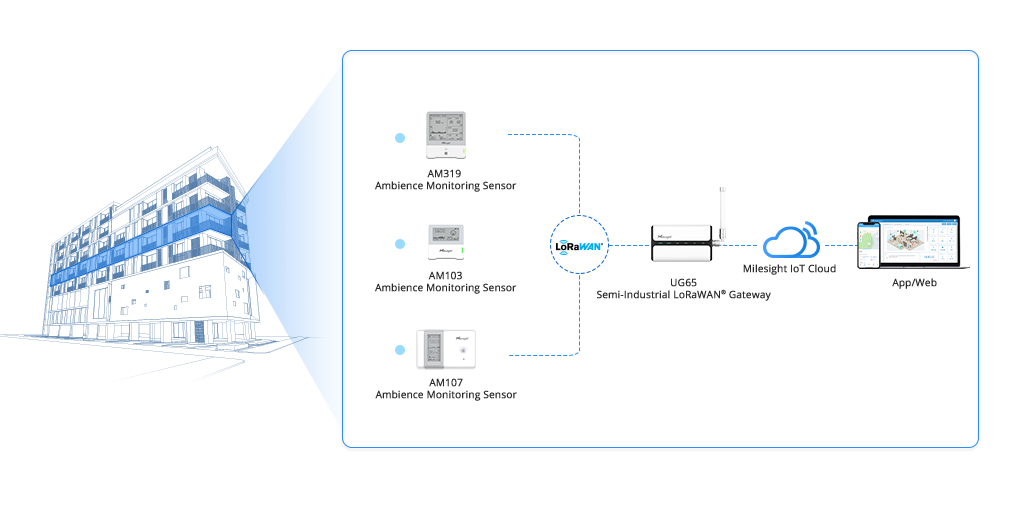
By applying Milesight IAQ Sensors in buildings, occupants can get to know the CO2 level in room air as well as various attributes correlated to indoor air quality, such as humidity, temperature, TVOC, etc., through a 4.2-inch E-ink screen. Besides, the traffic light status indicator could help users understand their environment visually. Once the CO2 intensities reach the threshold, the Milesight IAQ sensor will immediately send out the alert to Milesight IoT Cloud through UG65 LoRaWAN® Gateway. So that it can offer users an indication of increasing the ventilation frequency.
What makes this solution even more attractive is the intelligent trigger system of Milesight IoT Cloud. It visualizes field data and enables users to monitor and control remote assets on an intuitive dashboard. In this solution, Milesight IoT Cloud can automatically turn on the individual fans, ventilation system, and any other equipment for ventilation with the help of the ventilation controller.
Featured Product
Benefits
- Long-term Health Benefits
Monitoring the CO2 in room air in real-time and increasing ventilation rates in time could help decrease the prevalence of SBS symptoms and drive long-term health benefits.
No need to turn the ventilation system on all the time. Users can only activate it when an alert is received by which can help save energy and further reduce carbon emissions, thus facilitating a more sustainable way to live.
- To Curb the Spread of Disease
During the Covid-19 pandemic, the IAQ sensor could help people to live in safer and healthier facilities through real-time air quality monitoring and alert.
Within the acceptable range of CO2 levels and with the improvement of IAQ, people’s ability to concentrate and problem-solving can be significantly enhanced.
This article, attributed to Milesight can be found at Milesight
Milesight products can be purchased at IoTdc, please contact:
|
Theo Barnard
|
|
Head of Product
|
|
|
|
|
|
|
|
|
|
|
|
The Point Business Park, Unit
B3, 7 Sterling Road, Samrand, Gauteng, South Africa, 0187
|
 |


